
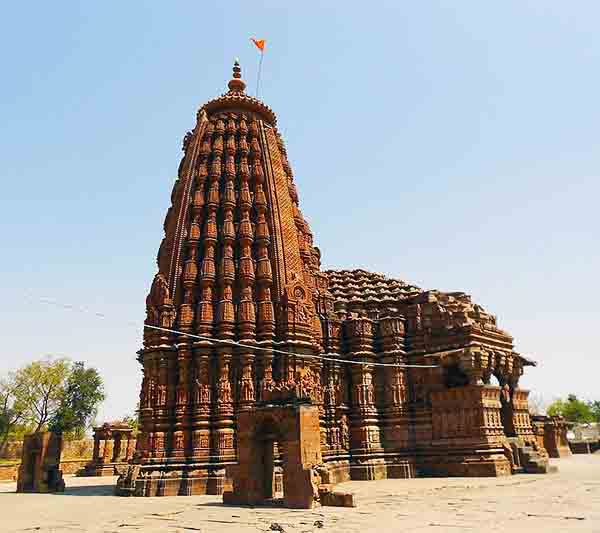
One of the finest examples of Bhumija style of architecture is the ancient Udayeshwara Mahadeva Temple in Udaipur. This city as per Sanskrit inscriptions was founded by the Paramara king Maharaja Udayaditya of Malwa, brother of Maharajadhiraja Bhoja who also designed a kund known as Udayasamudra.
According to the many Sanskrit inscriptions found in the Udayeshwara Temple, the construction of this grand edifice commenced in 1059 CE and was completed in 1080 CE.
The temple built in red sandstone (pink coloured sandstone) stands majestically in a square courtyard that has rectangular projections in the centre of each side. The low enclosure wall is adorned with carvings on the outer face while stone seats with balustrades run along the inner face.
Though the main entrance to the temple is on the east, there are entrances marked on each side with a flight of steps and dwarapalakas on either side that have now been closed. The temple originally had eight smaller shrines placed in accordance with the tenets of the Shilpa Shastra.
However, two shrines have completely disappeared while the other six are in a state of disrepair with their shikharas on the verge of collapse or severely damaged. The traditional Vedi, a square room meant for the performance of yagnas (sacrificial fire) is seen in front of the main temple. Its roof has since fallen off.
A similar square shrine is seen at the rear of the temple that was demolished by the Muslim barbarian Muhammad bin Tughluq. A mosque was built on its debris between 1336 to 1338 CE.
The main temple has three entrance porches (pravesa mandapa), a sabha mandapa and a garbha griha in which Bhagawan Shiva in the form of a Shiva Linga is consecrated on a high pedestal. The Shiva Linga has now been covered with a brass sheet that is removed on the auspicious occasion of Maha Shivaratri. According to the locals, the first rays of the sun fall on Bhagawan Shiva on the two equinoxes.
This brass covering with Bhagawan Shiva’s face in relief was offered by Khande Rao Appaji, a general of the Maratha war veteran Mahadji Scindia. The entrance doorway is richly embellished with artistic details often seen in temples of the olden times.
The original figure of Bhagawan Nandi was destroyed by Muhammad bin Tughluq and replaced sometime in the late 18th century. The pillars and seats in the entrance porches on the three sides of the sabha mandapa have Sanskrit inscriptions and historical records.
The exterior facades are a visual spectacle with exquisite sculptures of gods and goddesses, Bhagawan Brahma, Bhagawan Vishnu, Bhagawan Ganesha, Bhagawan Kartikeya, Ashtadikpalakas in their respective positions and various forms of Bhagawan Shiva and Durga Devi. The facial expression, body posture, garments and jewellery of the sculptures has been executed with great precision and delicacy.
There are pyramidal roofs over the entrance porches and the hall while there is a magnificent shikhara over the sanctum sanctorum. The shikhara is truly an artistic and architectural marvel with intricately carved miniature niches in repetition, medallions inset with gods and goddesses, geometric patterns in harmony and auspicious Hindu iconography.
There is a lone human figure sitting near the pinnacle of the shikhara that is widely interpreted to be the architect of the temple who turned to stone overnight.
Historians, architects and artists have often remarked that this temple is an architectural gem of unparalleled beauty, elegance and grandeur.
Written by Lakshmi Subramanian
 sahasa.in
Leave a comment