
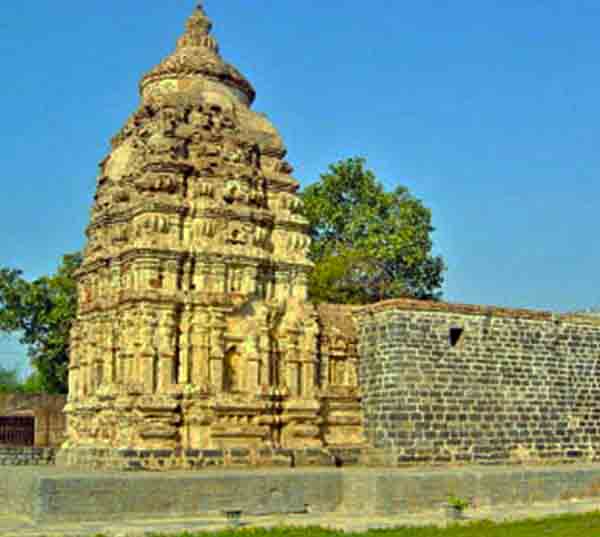
Kharod, a relatively sleepy town is a lesser – known treasure trove of ancient brick temples. This town of immense religious and spiritual potency is said to derive its name from Khara and Dushana, the younger brothers of Ravana. The great war between Khara and Dushana and Bhagawan Rama is said to have taken place here.
Historical records state that countless brick temples were built in this area of which only four remain today namely Shavari Devi Temple, Andal Deul, Lakshmaneshwar (also known as Lakhneshwar) Temple and Eeshaaneshwar Temple.
The Shavari Devi Temple (known locally as Shabari Devi or Shabarinarayana Temple) is located in the southern part of the village on the west bank of an old tank. This east – facing temple sits on a high stone platform and on plan has a pillared mandapa, an antarala and a square garbha griha.
The sanctum sanctorum interestingly has been designed as a saptaratha representing a stellar (star) though it hasn’t been completed in entirety and therefore, appears to be only a semi – stellar.
The external facades are relatively simple in terms of decoration with mouldings, niches that are empty, repetitive linear elements and auspicious Hindu iconography.
The entrance door to the shrine has the river goddesses Ganga and Yamuna of very small size, dwarapalakas and prominent carvings of the Nagas. Garuda sits on the lintel holding the tails of serpents.
The mandapa has two rows of six pillars each. The sculptures adorning the pillared mandapa though defaced are classical in their ornamentation, size and proportion. There are sculptures of other temples placed here as well.
The temple was dedicated to Bhagawan Vishnu originally but later seated the local goddess Savari Devi. This temple was built in the mid – 7th – early 8th century by the Panduvamshis of Dakshina Kosala and the mandapa was an addition by the rulers of this region in the late 12th century.
Written by Lakshmi Subramanian
 sahasa.in