
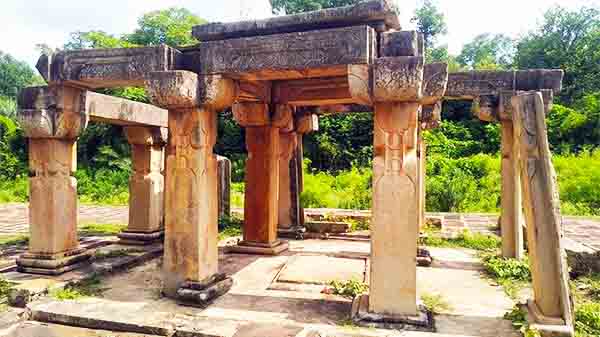
Bhim ki Chauri (marriage pavilion of Bhima), a mid – late 5th century edifice of possibly the Guptas or their feudatory, the Aulikaras presents a lonely picture in the midst of stunning natural beauty. This temple located in the lush green Mukundara Hills National Park is believed to be the only surviving structure of that period in this area that was once a part of the princely region of Hadoti.
The temple (or whatever is left of it) sits on a low platform accessed by two lateral flight of steps. This east – facing temple on plan originally had a pillared Nandi mandapa of which only fragments are seen today and a garbha griha.
The sanctum is clearly marked by four columns and was placed at the centre of a square bay. There were walls on the south, west and north of the shrine with decorated pilasters and columns. A narrow pradikshina path can be seen around the open pillared sanctum sanctorum.
The lintels are simplistically embellished with floral and foliage motifs, bead like work and concentric linear patterns while the capitals of the pillars are adorned with intricately carved floral and geometrical designs. The ceiling of the mandapa has a beautiful panel of a full – bloomed lotus in the centre with four smaller lotuses at the four sides.
The walls most likely made of brick have disappeared altogether. Parts of the pillars, lintels, ceiling panels and other architectural elements are seen and have also been preserved by the Archaeological Survey of India (ASI). A gana and a drummer (Jhallari Vadak) from this site are on display at the Government Museum at Kota.
This flat – roofed temple also has the traditional makara pranalas that are of great antiquity. It is most unfortunate that a considerable portion of this ancient temple was broken and used to build a mansion in the 17th century by the local ruler as well as a Shiva Temple behind the mansion and the deserted temple at Jhamra.
However, the search is still on for the missing walls, doorways, architectural details and ceiling panels of this old temple.
Written by Lakshmi Subramanian
 sahasa.in
Leave a comment