
Maharana Kumbha is considered to be one of the finest architects of the 15th century and highly proficient in Sanskrit, ancient Hindu literature, scriptures and treatises particularly the Shilpa Shastra. Every edifice commissioned by him has proved to be an excellent example to understand the science of Hindu philosophy and tenets of Shilpa Shastra.
The Vedi Temple built in 1457 CE is one such iconic structure designed only for the performance of yagas and yagnas. This unique complex is perhaps the last surviving structure of its kind.
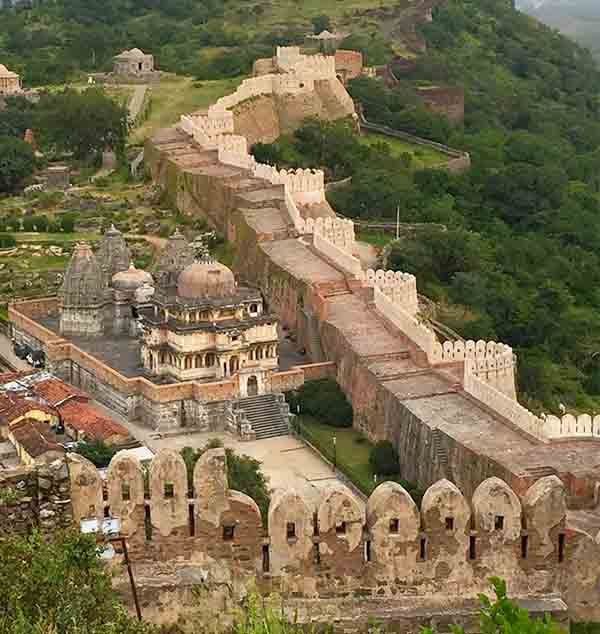
This west – facing temple complex located to the right of the imposing Ram Pol has high enclosure walls on three sides. Also known as Yagna Vedi, the complex sits on a raised platform and comprises of a three – storeyed pillared Yagna Vedi (mandapa or hall where yagnas are performed), a square chhatri in the middle and triple shrines behind.
Interestingly, Yagna Vedi has been designed as an octagonal hall with the precise placement of the pillars. It has a domical roof over it. There are intricate carvings on the central roof panel.
The square chhatri is a small structure supported by four pillars and open on all sides. The triple shrines on plan has a pillared mandapa and a large hall that provides access to the three shrines on the north, east and south.
Two of these sanctums are now empty while Lord Vishnu is consecrated in the third. Unfortunately, the features of this idol have eroded over time. Lord Garuda along with some other gods are seen on either side.
There are curvilinear shikharas over the shrines and domical roofs over the pillared halls. The complex was renovated by Maharana Fateh Singh.
It is however unclear when and why this temple came to be listed as a Jain Temple when auspicious Hindu iconography is visible in every part of the temple complex.
Written by Lakshmi Subramanian
 sahasa.in
Leave a comment