
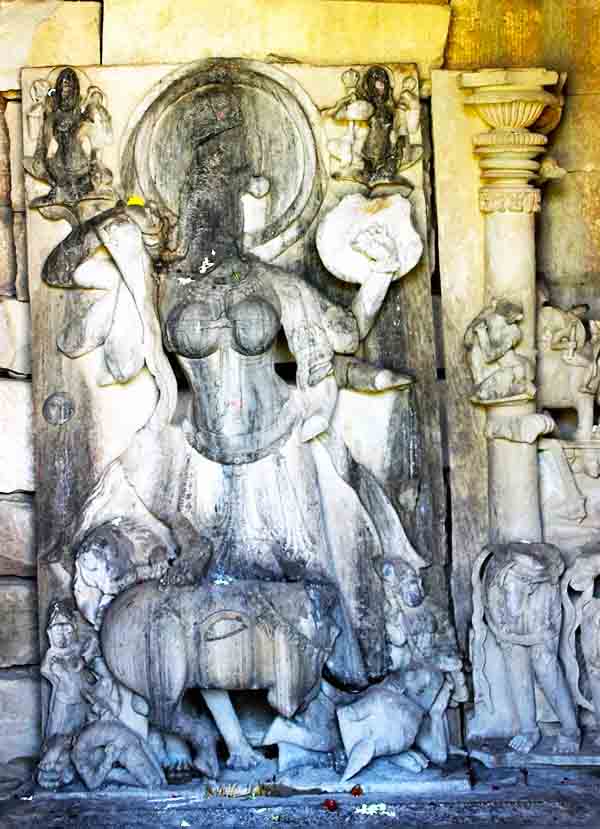
One of the most beautiful temples in the Baroli group of Temples is the 10th century Ashtamata Temple. This temple built by the Gurjara – Pratiharas in the typical Nagara style of architecture is an outstanding example of subtle elegance combined with exquisite craftsmanship.
The temple also known as Mahishasura Mardini Temple faces east and has a mukha mandapa, an antarala and a garbha griha. The sanctum designed as a pancharatha with ten – tiered shikhara conforms to the tenets of the Shilpa Shastra. The shikhara is an artistic masterpiece with its embellishments, auspicious Hindu iconography and geometric harmony.
The entrance doorway is yet another visual spectacle with a dancing Maheshwari in the Lalata Bimba flanked by Brahmani and Vaishnavi. There are niches on either side of the doorway with carvings of Devi on the top.
The main idol of Durga Devi as Mahishasuramardini is considered by historians and artists to be a rare and fine piece of sculpture. The original idol is now severely mutilated and stands testimony to the artistic and architectural mastery of the Gurjara – Pratiharas.
The capitals of the pillars in the mukha mandapa have panels of goddesses. Every part of the external façade is decorated with floral and foliage motifs, repetitive elements and linear patterns.
According to the locals, Chhatrapati Shivaji Maharaj took refuge in this temple after he escaped from the clutches of the Muslim barbarian Aurangzeb. This temple took the brunt of the wrath of the religiously intolerant Aurangzeb and the British who damaged the main idol consecrated in the sanctum sanctorum, the temple structure and sculptures.
This temple complex is under the protection of the Archaeological Survey of India (ASI).
Written by Lakshmi Subramanian
 sahasa.in