
Bilasgarh, a treasure trove of ancient ruins and artefacts was once dotted with temples (dating back to the Vedic Period), forts, dharmashalas, Gurukulas and bhojanashalas. Archaeological excavations around this area uncovered caves with prehistoric drawings and petroglyphs.
According to historical documents, this city located on the banks of a tributary of the Parbati River was once a part of the princely region of Hadoti which was ruled by the Paramaras, the Gaud Brahmins and the Khichi Chauhan dynasty.
Bilasgarh was formerly known as Krishnavillas or Vilasnagara or Vilasa owing to the countless number of temples dedicated to Bhagawan Vishnu. One historical document refers to it as Karkotanagara or Nagara, the capital city of the Malavas of Rajasthan.
The discovery of punch – marked coins as well as Malava coins which bear the famous line ‘Malavanam jayah‘ and ‘Malava Ganasya jayah‘ dated to between 3rd century BCE (250 BCE) and 2nd century CE have supported this theory that this town of great antiquity was indeed a seat of learning, Vedic philosophy, art and architecture.
The prosperity of this town up till the 10th century has been well – documented in many literary works. Court records of the Muslim barbarians from the late 10th century onwards reveal repeated attacks on this flourishing town. Aurangzeb, on hearing about its opulence through his governor did not spare the grand temples and people of this city.
Broken carved panels and sculptures, ornamental plinths, damaged yonis that once seated Shiva Lingas and defaced and mutilated images of gods and goddesses and inscriptions stand as a testimony to his barbarism.
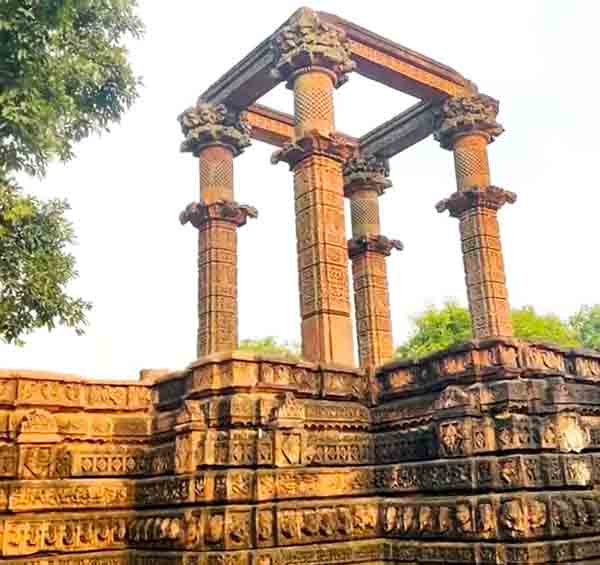
The now completely ruined Vishnu Temple is one such edifice belonging to the late 9th – early 12th century found in the midst of the ruins. The original temple built in red sandstone stood on a raised platform that has richly embellished tiers of elephants, nagas, figures, dancers, geometric and floral patterns, repetitive elements, miniature niches inset with gods and goddesses, auspicious Hindu iconography and intricately carved sculptures of the various forms of Bhagawan Vishnu.
It would appear on plan that the temple had an entrance porch, a pillared mandapa, an antarala and a rectangular garbha griha which most likely seated an idol of Bhagawan Vishnu on a pedestal. This pillared mandapa has a square space in the middle with four profusely decorated pillars known as the Charkhambha (four pillars). The roofless Chaukhamba has elaborately carved beams and pillars.
Some of the notable sculptures are of Yoga Narayana, Anantasayana, Bhagawan Krishna playing the flute, Dasha Avatar and Vishnu Varaha. About 15,000 broken sculptures were found in the debris.
Written by Lakshmi Subramanian
 sahasa.in
Leave a comment