
Kaman also known as Adi Vrindavan is a town of great antiquity that has been mentioned in the Srimad Bhagavatha Mahapurana as the holy land where Bhagawan Krishna spent his childhood days. This sacrosanct town is home to Kameshwar Mahadev Temple, one of the four important Shivalayas on the Braj Chaurasi Kos Yatra.
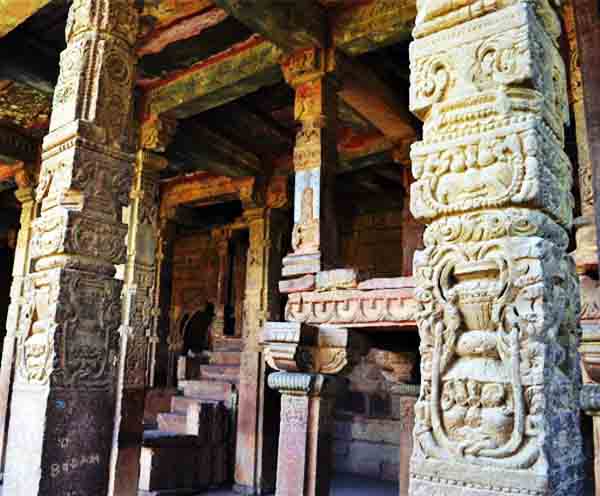
The most mysterious edifice in this town is the Chaurasi Khambha Temple whose pillars though literally translates to 84 in number (chaurasi means eighty – four) have never added up to 84! Several people have even numbered the pillars in white chalk only to find themselves at their wits’ end when the final number has either exceeded or is lesser than 84.
No one has been able to explain why it is so hard to count these pillars that locals believe have existed since the time of the Pancha Pandavas. In fact, Kaman is said to be the place where the Pancha Pandavas and Draupadi spent time in tapas (penance and austerities) during their exile.
The legendary Yaksha Prasna also happened in this village at a pond called Dharam Kund. The other fascinating feature of this temple is that though it is generally accepted to be a place of worship, there is no record of an idol of any kind!
The villagers also opine that Maharajadhiraja Vikramaditya, the epitome of dharma built this structure during his reign as there is a prominent elevated seating which is generally regarded as the seat of the king while holding court.
The pillars from the base to the capital are adorned with stunning carvings, motifs of flowers, pots, snakes, animals and birds, repetitive patterns and auspicious Hindu iconography. There are bas – reliefs of the Navagrahas, different forms of Bhagawan Vishnu, the union of Bhagawan Shiva and Parvati Devi, Nagas and others,
There are exquisite sculptures of Bhagawan Ganesha, Kali Mata, Bhagawan Vishnu and Bhagawan Narasimha. One pillar has the sacred mantra “ॐ नमः शिवाय” inscribed on it. Historians claim that the temple was built in the 8th century CE though parts of it appear to be much older.
This temple was desecrated by the Delhi Sultanate and partly converted into a mosque using the debris.
Written by Lakshmi Subramanian
 sahasa.in
Excellent article. I visited this great architecture and religious place. My observations are following which needs attention:
1. Chaurasi Khambha carvings are unique but hand carved orginal stone pieces have been replaced by machine carved stone and slowly and continuously unnoticibly happening , vigilance is required
2. Area is not properly maintained by ASI/ state dept
3. Very close surrounding has been occupied by shops, locals residence
4. Needs attention to save
LikeLike